How Accurate is Vedic Astrology?
Years ago, a famous Vedic astrologer did a reading of my birth chart. I was extremely skeptical about astrology but had heard that he was pretty amazing. He told me things about myself that were quite accurate. But what really made me take notice was what he told me about my childhood, relationships with sibling and my parents, details he couldn’t have possibly known, especially back before the Web and social media.
A few years ago, I decided to investigate how an astrologer could see with such accuracy such detail. I bought GeoVision Software, Inc. Parashara’s Light Desktop Edition for my Mac, assuming I would be able to figure it all out. Vedic astrology, or Jyotish, is different than Western astrology. Anyone that has attempted to learn Jyotish knows that it is a daunting task. But recently, I began using AI (both ChatGPT and Claude) as tutorial aids to analyze and interpret charts. Astrological analysis and interpretation is a perfect use case for AI. These AI implementations know the traditional texts, ancient and modern commentaries and have a wealth of examples from published papers to draw from—more than any one astrologer could possibly have access.
To prove my point, what follows is the analysis and interpretation of a prominent politician’s chart done in collaboration with ChatGPT. See if you can guess who it is.
Preparation
After trying various AI’s, GPT’s and methods, for this chart I settled on creating a ChatGPT Project with a source file defining project instructions for analysis and parsing chart and table images into reusable JSON datasets. After building out the dataset, I begin step-by-step analysis following traditional methods using the ChatGPT session to document the process. What follows is the outcome of one such session. I will not disclose the name, birthdate and time, and the birthplace, but I think it will be apparent who this reading is about.
Birth Chart
This is the North Indian-style birth chart that was uploaded and parsed. The house positions are fixed, with the 1st house being in the upper middle diamond. Subsequent houses are read around the chart counter-clockwise. The numbers correspond to the signs. In Vedic astrology, the ascendant, or lagna, is key. The chart below shows Leo (5) ascendant, Virgo (6) in the 2nd house, Libra (7) in the 3rd, Scorpio (8) in the 4th, etc.
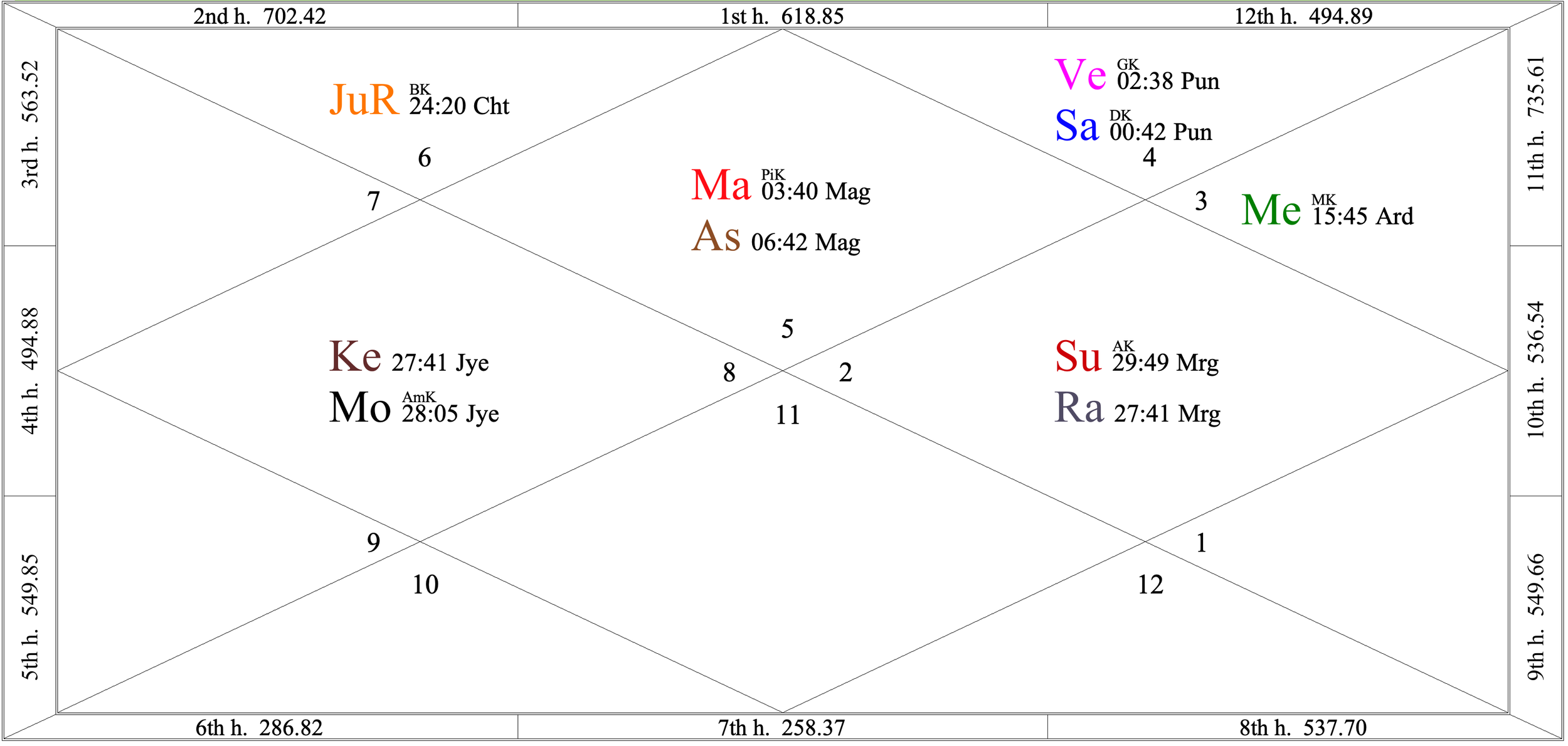
D1
Navamsha Chart
The Navamsha chart (D9), is used to analyze relationships, including spousal relationships and other developments as the person matures and ages.
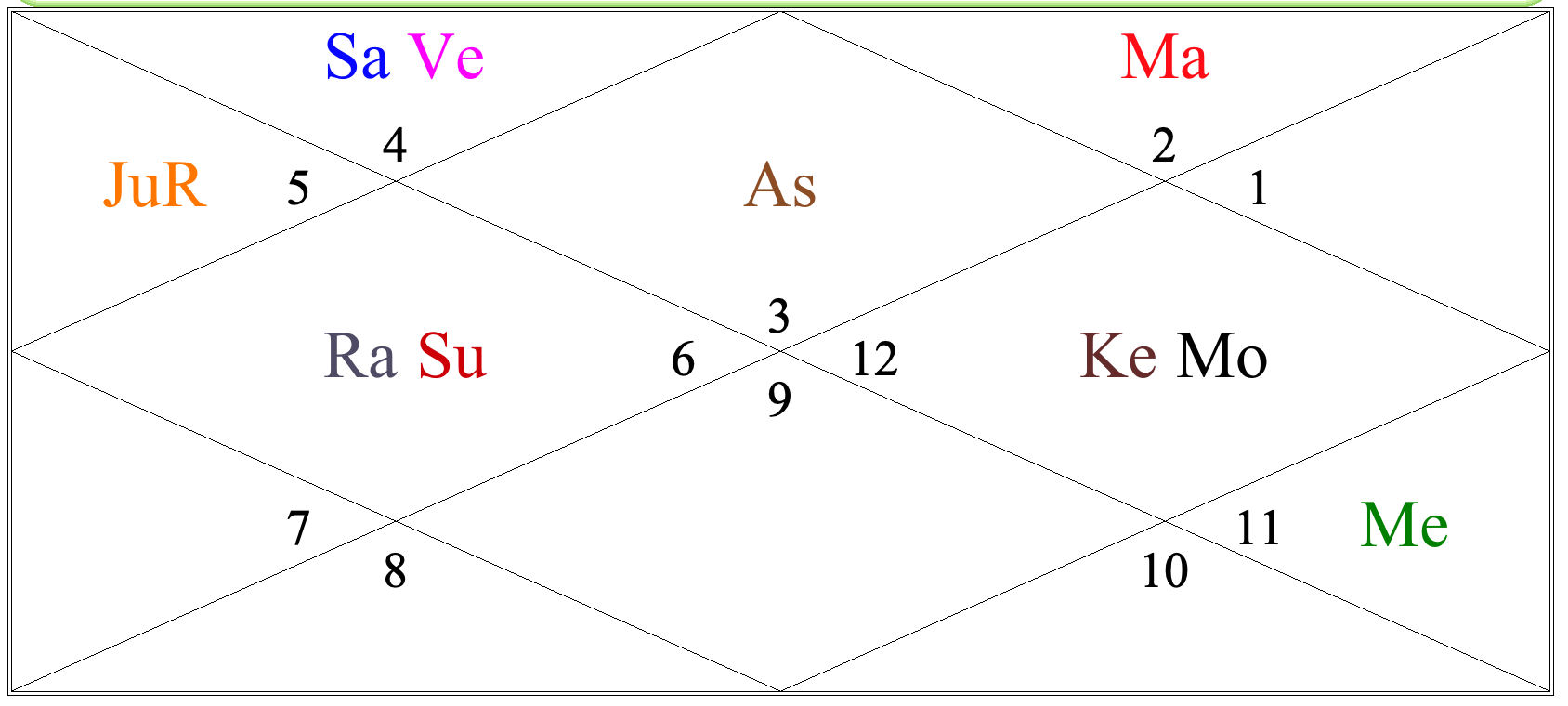
D9 - Spouse
Dashamsha Chart
The Dashamsha (great successes) chart is used to further analyze business dealings and successes.
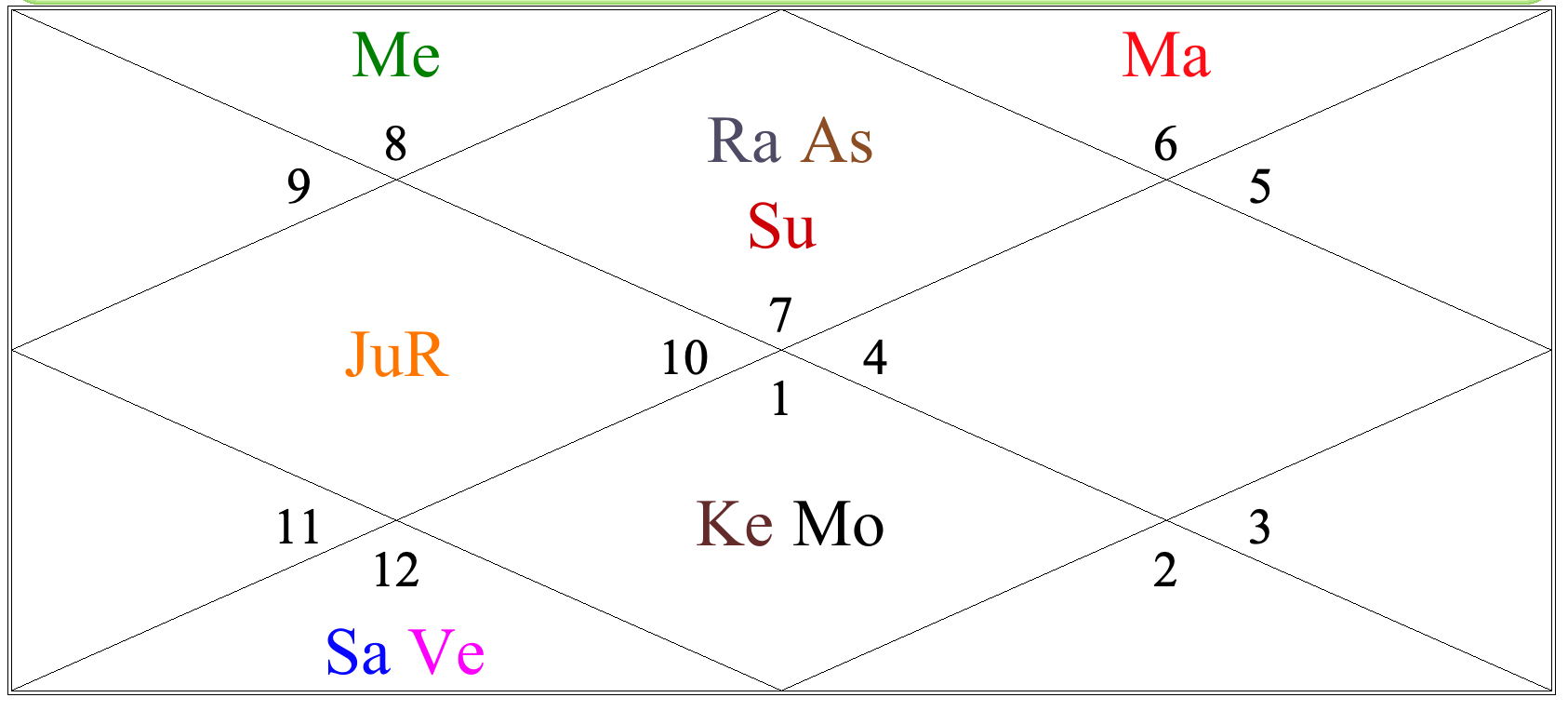
D10 - Great Successes
Other information uploaded to detail the strength of planets and houses, Vimshottari dashas used to determine timings of events, etc.
The Request
After creating the dataset, I issued the following request:
“Analyze this chart step-by-step. This isn’t for a client, so you don’t have to write client-friendly versions. I want to know everything in detail from a traditional perspective. Please explain how you arrive at the interpretations you give in a clear, concise and accurate way to help me correctly analyze and interpret the chart.”
The Analysis and Interpretation
Below is a traditional, step-by-step analysis using the dataset we assembled. I’ll focus on method first, then interpretation. I’ll avoid client-softening and keep the logic explicit.
1. Start with the frame: Leo Lagna, Magha rising
The Ascendant is Leo 6°42′35″ in Magha pada 3.
Leo rising immediately makes the chart solar, royal, self-expressive, status-oriented, and concerned with recognition. Magha adds the ancestral/throne quality: lineage, entitlement, inherited prestige, ceremonial power, old-family karma, and a strong instinct to sit “at the head of the table.”
Traditional rule: the Ascendant shows the body, temperament, self-projection, and life-direction. The Ascendant lord shows how that life-direction expresses itself.
Here the Ascendant lord is the Sun, placed in the 10th house of public status, authority, career, command, reputation, and visibility. This is one of the central signatures of the chart: the life-force is thrown into the public arena.
So before looking at anything else, the skeleton is:
Leo Lagna + Sun in 10th = identity, authority, reputation, visibility, command.
Magha rising = dynastic/ancestral/status consciousness.
This is not a private-life chart. It is fundamentally a public-power chart.
2. Functional benefics and malefics for Leo Lagna
For Leo rising, the planets function as follows:
Planet Houses ruled Functional roleSun 1st Lagna lord, self, body, authorityMoon 12th Loss, isolation, sleep, foreignness, retreat, hidden lifeMars 4th and 9th Yogakaraka; very important benefic for LeoMercury 2nd and 11th Wealth/gains lord, but also maraka and acquisitiveJupiter 5th and 8th Mixed: 5th lord benefic, 8th lord transformativeVenus 3rd and 10th Career lord, but functionally difficult due to 3rd lordshipSaturn 6th and 7th Functional malefic; enemies, litigation, disease, partners, contractsThis is crucial. Do not judge only by natural benefic/malefic status. For Leo:
Mars is extremely important because it rules both a kendra, the 4th, and a trikona, the 9th.
Saturn is difficult because it rules the 6th and 7th.
Venus is the 10th lord, so it matters greatly for career, but it is not cleanly benefic because it also rules the 3rd.
3. The most important configuration: Sun + Rahu in the 10th house
The 10th house is Taurus. It contains:
Sun 29°49′ Taurus, AtmakarakaRahu 27°41′ TaurusThis is one of the dominant signatures of the chart.
The Sun, as Lagna lord, in the 10th house gives public visibility, command, fame, desire for status, and life organized around achievement. But the Sun is with Rahu, which magnifies, distorts, electrifies, and destabilizes whatever it touches.
Traditional meaning of Sun + Rahu:
hunger for recognition;
unconventional relationship with authority;
public controversy;
inflated or unusual self-presentation;
eclipse-like karma around father, king, government, power, or legitimacy;
mass visibility, especially in nontraditional or disruptive ways.
Because this occurs in the 10th, the effect is not hidden. It becomes career, reputation, public image, status, office, and visibility before the world.
Rahu in the 10th can produce extraordinary worldly ambition. It often breaks conventional rules of respectability. It wants status, but not necessarily through clean or traditional means. It thrives in spectacle, disruption, image, controversy, and mass attention.
The Sun is also Atmakaraka, the planet with the highest degree among the seven karakas. That makes Sun themes even more existential: identity, power, sovereignty, pride, recognition, command, father, king, office.
So the core soul-pattern is:
Atmakaraka Sun + Rahu in 10th =soul driven toward public power, recognition, authority, and extraordinary visibility,but through Rahu-like exaggeration, disruption, controversy, and karmic instability.This is a major fame signature, but not a peaceful one.
4. Mars in the 1st house: yogakaraka in Lagna
Mars is in Leo in the 1st house:
Mars 3°40′ Leo, Magha pada 2, PitrikarakaFor Leo Lagna, Mars rules the 4th and 9th houses. This makes Mars the yogakaraka, a planet capable of producing strong raja yoga because it combines kendra and trikona lordship.
Mars in the 1st gives:
forceful personality;
combative self-presentation;
courage;
aggression;
competitiveness;
command instinct;
willingness to fight;
bodily vitality;
impatience;
dominance.
Because Mars rules the 9th, this also brings fortune, father/guru/dharma karma, and protection into the personality. Because Mars rules the 4th, it ties real estate, land, vehicles, property, homeland, emotional foundations, and throne/seat directly to the self.
This is one reason the chart has a very strong “I am the seat / I am the property / I am the kingdom” quality.
Mars aspects:
4th house Scorpio by its special 4th aspect;
7th house Aquarius by its 7th aspect;
8th house Pisces by its special 8th aspect.
Its 4th aspect lands on Moon + Ketu in Scorpio, which is very important. The yogakaraka energizes the 4th house, but in a harsh martial way. This gives property strength, but also emotional volatility, family agitation, and conflict around home/mother/land.
The key rule:
Yogakaraka Mars in Lagna = power, initiative, fortune, property karma, self-assertion.Mars aspecting Moon/Ketu in 4th = inner agitation, emotional rupture, property/family intensity.5. Moon + Ketu in the 4th house: the inner wound
The 4th house is Scorpio. It contains:
Moon 28°05′ Scorpio, debilitated, AmatyakarakaKetu 27°41′ ScorpioThe Moon is debilitated in Scorpio. It is also close to Ketu. This is one of the most psychologically revealing parts of the chart.
The 4th house signifies:
mother;
emotional security;
home;
inner peace;
homeland;
throne/seat;
real estate;
vehicles;
private happiness;
the heart.
Moon in the 4th would normally make the inner life, mother, public appeal, and emotional responsiveness important. But the Moon is debilitated in Scorpio and conjoined Ketu.
Traditional meaning:
emotional insecurity;
difficulty feeling inwardly settled;
separation from maternal comfort;
intense subconscious reactions;
suspicion;
emotional extremes;
compulsive need for control;
private unrest beneath public confidence;
karmic detachment from ordinary domestic peace.
Ketu with Moon often gives a severing or dissociating quality. It can produce intuitive sharpness, but also emotional disconnection, instability, or a sense that ordinary emotional nourishment is insufficient.
This becomes more intense because the Moon is in late Jyeshtha, a sharp and senior nakshatra associated with power, protection, hierarchy, rivalry, and psychic intensity. Late Scorpio also has a gandanta-like intensity: knots at the end of a water sign, where emotional karma can be difficult to untangle.
The Moon is also Amatyakaraka, the significator of action, execution, career-function, and how the soul operates in the world. So the public action pattern is not calm. It comes from a deeply reactive, defensive, emotionally charged place.
Key synthesis:
Moon debilitated with Ketu in 4th = inner insecurity, disrupted emotional roots, intense home/property karma, and a private life that does not easily produce peace.Because Moon is Amatyakaraka, this inner emotional pattern becomes part of the public-action style.6. The 4th/10th axis: private instability versus public hunger
This chart has a heavily activated 4th/10th axis:
10th: Sun + Rahu4th: Moon + KetuThis is an eclipse-axis across the private/public line.
The 4th is private life, emotional roots, home, land, and mother.
The 10th is public life, status, power, career, and father/authority.
Rahu in the 10th pulls toward public visibility and worldly dominance. Ketu in the 4th detaches from ordinary private contentment. This gives a classic pattern:
less peace in the private interior, more hunger for public recognition.The person may seek in the 10th what is missing in the 4th: validation, status, applause, control, and a visible throne.
Because the Sun aspects the 4th from the 10th, and Mars also aspects the 4th from the Lagna, the 4th house receives powerful, hot, egoic, martial influence. This is excellent for property karma and domination of territory, but hard for softness, contentment, or emotional rest.
7. Mercury in the 11th house: gains, networks, speech, commerce
Mercury is in Gemini in the 11th house:
Mercury 15°45′ Gemini, own sign, MatrikarakaMercury rules the 2nd and 11th houses for Leo Lagna. These are both wealth houses:
2nd: accumulated wealth, speech, family assets;
11th: gains, networks, fulfillment of desires, large circles, influence.
Mercury in its own sign in the 11th is extremely strong for commerce, deal-making, messaging, networking, persuasion, branding, and gains through communication.
This is one of the clearest wealth/gain signatures in the chart.
But because Mercury rules both 2nd and 11th, it is highly acquisitive. It can make the mind transactional: “What do I gain? Who is useful? What is the deal? What is the leverage?”
Mercury is in Ardra, ruled by Rahu. Ardra adds storm, disruption, sharp speech, provocation, media, and the capacity to break things apart verbally or intellectually. Mercury in Ardra is not gentle Mercury. It is cutting, performative, disruptive, clever, and often controversial.
Key rule:
2nd/11th lord Mercury in own sign in 11th = strong gains, networks, speech, commerce, deal-making.Mercury in Ardra = sharp, disruptive, provocative communication.This strongly supports wealth through speech, media, messaging, negotiation, and networks.
8. Jupiter in the 2nd house: wealth, family karma, speech
Jupiter is in Virgo in the 2nd house:
Jupiter 24°20′ Virgo, retrograde, Chitra pada 1, BhratrikarakaFor Leo Lagna, Jupiter rules the 5th and 8th houses. This makes Jupiter mixed.
The 5th lord in the 2nd is favorable for wealth, intelligence, lineage, name, children, speculation, and the ability to convert merit into resources. This is a dhana yoga-type placement.
But Jupiter also rules the 8th. The 8th lord in the 2nd brings hidden wealth, inheritance, family entanglements, tax/debt/legacy issues, scandals, and transformations involving money and speech.
Jupiter aspects:
6th house Capricorn;
8th house Pisces;
10th house Taurus.
The 10th aspect is crucial: Jupiter aspects Sun + Rahu in the 10th. This gives protection, expansion, and legitimacy to the public-career axis. It does not remove Rahu’s distortion, but it gives the 10th house more capacity to produce major results.
Jupiter is retrograde, which often internalizes or intensifies the planet. It can make Jupiter less straightforward: moral judgment, law, counsel, advisors, and principles become complicated or self-referential.
Key synthesis:
5th lord Jupiter in 2nd = wealth, intelligence, family name, speculative capacity.8th lord Jupiter in 2nd = inheritance, hidden money, scandal, debt/tax/legal entanglement.Jupiter aspecting 10th = career expansion and protection.This is a strong wealth placement, but not a clean or simple one.
9. Venus + Saturn in the 12th house: career cost, pleasure, loss, contracts
The 12th house is Cancer. It contains:
Venus 2°38′ Cancer, GnatikarakaSaturn 0°42′ Cancer, DarakarakaThis is very important because Venus is the 10th lord. The career lord is placed in the 12th.
The 12th house signifies:
loss;
expenditure;
foreign places;
sleep;
bed pleasures;
isolation;
institutions;
retreat;
hidden enemies;
confinement;
behind-the-scenes activity;
spiritual release;
waste and luxury.
The 10th lord in the 12th can give career connected with foreign lands, luxury, hotels, retreats, large institutions, private deals, or expenditure. But it also indicates career losses, hidden costs, scandals, or periods where reputation is drained.
Venus is strong by Shad Bala, but qualitatively troubled:
Venus:Shad Bala ratio: 1.47Dignity: Great EnemyVimshopaka Bala: 6Avastha: DeadFunctional nature: MaleficThis is a classic case where a planet has quantitative strength but poor qualitative condition. It can produce results, but through difficulty, excess, compromise, or cost.
Saturn is even more problematic:
Saturn:Shad Bala ratio: 0.59Dignity: Great EnemyVimshopaka Bala: 5Avastha: DeadDarakarakaFunctional maleficSaturn rules the 6th and 7th. So the 6th lord and 7th lord is in the 12th with the 10th lord.
This combines:
enemies/litigation/debt/service/conflict;
marriage/partners/contracts/open opponents;
career/status;
loss/expenditure/foreignness/isolation.
So Venus + Saturn in the 12th shows that public career, partners, contracts, litigation, losses, expenses, pleasures, and private arrangements are deeply entangled.
Saturn as Darakaraka being weak and in the 12th is difficult for marriage and partnership stability. It does not deny relationships, but it shows karmic heaviness, distance, transactional bonds, separation themes, or burden through partners.
Key synthesis:
10th lord Venus in 12th = career tied to luxury, foreignness, expenditure, hidden costs, and loss.7th lord Saturn in 12th = partnership karma, separation, contractual burdens.6th lord Saturn in 12th = litigation/enemy themes behind the scenes.Venus + Saturn = pleasure and burden fused together.This is one of the major signatures for high material life mixed with relational and legal complications.
10. House strength pattern
The strongest house by the border values is the 11th:
11th house: 735.612nd house: 702.421st house: 618.85The weakest are:
7th house: 258.376th house: 286.82This is very telling.
Strongest houses:
11th: gains, networks, large groups, fulfillment of desires;
2nd: wealth, speech, family resources;
1st: self, body, personal force.
Weakest houses:
7th: spouse, partners, agreements, public opponents;
6th: service, discipline, enemies, litigation, health routines.
This fits the whole chart:
Very strong self/gains/wealth axis.Weak partnership and service/cooperation axis.The person is not primarily built for equal partnership, humble service, or quiet compliance. The chart is much more oriented toward personal dominance, gain, public recognition, and self-driven command.
11. Shad Bala: which planets can deliver?
Shad Bala ratios:
Rank Planet Ratio1 Sun 1.60
2 Mars 1.51
3 Venus 1.47
4 Moon 1.46
5 Mercury 1.33
6 Jupiter 1.24
7 Saturn 0.59
The striking thing is that six of seven classical planets are above required strength. Saturn alone is markedly weak.
This means the chart has a lot of capacity to produce results. Even difficult planets are not inert. They act.
The Sun and Mars being the two strongest is very significant:
Sun strongest = authority, ego, visibility, command.Mars second strongest = aggression, initiative, combativeness, property/fortune.Venus is also strong, but as mentioned, qualitatively damaged. So luxury, women, pleasure, career, image, and 12th-house themes are powerful but problematic.
Saturn being weak is important because Saturn governs:
discipline;
restraint;
humility;
accountability;
contracts;
long-term burden;
labor;
service;
6th and 7th houses for Leo.
Weak Saturn shows difficulty with restraint, stable agreements, clean obligations, and cooperative structures.
12. D9/Navamsa: deeper dharma and relationship pattern
D9 Ascendant is Gemini.
Important D9 placements:
Sun + Rahu in Virgo 4thMoon + Ketu in Pisces 10thVenus + Saturn in Cancer 2ndMars in Taurus 12thMercury in Aquarius 9thJupiter in Leo 3rdThe first thing to notice is that the same karmic pairs repeat:
D1: Sun + Rahu / Moon + KetuD9: Sun + Rahu / Moon + KetuThis repetition means the eclipse pattern is not superficial. It is embedded in the deeper dharma chart.
The D9 again shows tension between inner life and public karma:
Sun + Rahu in the D9 4th;
Moon + Ketu in the D9 10th.
This confirms that the person’s life path is shaped by the conflict between emotional roots and public visibility.
Venus and Saturn are both in Cancer in D9, the same sign as in D1. That makes them effectively vargottama by sign.
Vargottama does not automatically mean benefic. It means the planet’s sign-condition is deeply reinforced. Here Venus and Saturn in Cancer become extremely important across life, marriage, family, speech, values, and karmic commitments.
Venus + Saturn in the D9 2nd suggests family and marriage karma tied to money, lineage, speech, public family image, emotional security, and accumulated resources. Saturn with Venus gives heaviness in affection: duty, age difference themes, transactional patterns, disappointment, or durability through burden rather than ease.
D9 7th house is Sagittarius, whose lord Jupiter is in Leo in the 3rd. That gives relationship karma involving pride, communication, self-effort, performance, media, and personal will. It is not a passive or quiet spouse pattern.
Key D9 synthesis:
The D9 repeats the eclipse axis and reinforces Venus/Saturn.Marriage/dharma themes are tied to speech, family wealth, emotional security, and karmic burden.The deeper chart does not soften the D1; it confirms it.13. D10/Dashamsha: career chart
D10 Ascendant is Libra.
Important D10 placements:
Sun + Rahu + Ascendant in Libra 1stMoon + Ketu in Aries 7thVenus + Saturn in Pisces 6thMercury in Scorpio 2ndJupiter in Capricorn 4thMars in Virgo 12thThis is a very loud career chart.
The D10 Lagna itself contains Sun + Rahu. In the career divisional chart, the identity is again fused with authority, mass attention, disruption, controversy, and hunger for visibility.
Sun in Libra is debilitated by sign, so the Sun’s authority is not clean or classically dignified in D10. But with Rahu in the D10 Lagna, it becomes visible, amplified, and unconventional. This is not quiet institutional authority. It is image-based, disruptive, and controversial authority.
The D10 10th house is Cancer. Its lord Moon is in Aries in the 7th with Ketu. This says career depends heavily on public confrontation, opponents, alliances, audience, and mass reaction. Ketu with Moon again gives volatility and rupture.
Venus, the D10 Lagna lord, is exalted in Pisces but placed in the 6th with Saturn. This is complex:
exalted Venus gives charisma, glamour, image, appeal, luxury, aesthetics;
6th house gives litigation, competition, enemies, conflict, service, crisis management;
Saturn adds burden, delay, contracts, labor, and institutional conflict.
So the career chart says:
Public image is enormous.Career thrives through conflict, opposition, litigation, competition, and spectacle.Charisma and luxury are strong, but entangled with enemies and burdens.D10 confirms the D1 rather than changing it.
14. Yogas and major combinations
14.1 Raja yoga through Mars
Mars rules the 4th and 9th and sits in the 1st. This is a powerful yoga.
Why?
9th lord in 1st connects fortune/dharma to self.
4th lord in 1st connects land/property/throne to self.
Mars is strong and in a friendly sign.
Mars aspects its own 4th house Scorpio.
This supports property, command, personal force, inheritance of power, and the ability to project strength.
14.2 Lagna lord in 10th
Sun as 1st lord in the 10th is a direct authority/fame combination.
It means self and career are fused. The person’s identity is public role. Reputation is not incidental; it becomes the stage of life.
14.3 Sun + Rahu: Grahana-type affliction
The Sun with Rahu creates an eclipse-like affliction. This does not prevent fame. Often it increases fame. But it makes fame karmically unstable and controversial.
It can show:
authority hunger;
distorted self-image;
father/king/government karma;
scandals around power;
public fascination mixed with public rejection.
14.4 Moon + Ketu
Moon with Ketu gives emotional dissociation, private insecurity, mother/home karma, and sharp intuition. In the 4th, this is especially strong for inner unrest.
14.5 Dhana combinations
Wealth is supported by:
Mercury, 2nd/11th lord, in own sign in 11th;
Jupiter, 5th lord, in 2nd;
strong 2nd and 11th house scores;
Rahu in 10th with Sun giving huge public reach;
Mars linking 4th/property and 9th/fortune to Lagna.
This is an extremely strong wealth/gain chart. But because the 8th lord Jupiter affects the 2nd, and the 12th is heavily loaded, wealth comes with debt, loss, litigation, inheritance issues, or hidden complications.
14.6 Partnership difficulty
Partnership difficulty is shown by:
7th house weakest by house strength;
7th lord Saturn in 12th;
Saturn weak by Shad Bala;
Saturn as Darakaraka;
Venus + Saturn conjunction;
Venus/Saturn in 12th in D1;
Venus/Saturn repeated in D9.
This is a strong repeated theme. It suggests partnership is karmically significant but not easy, equal, or emotionally simple.
15. Dasha sequence: how the life unfolds
Mercury/Saturn at birth
Birth occurs in Mercury Mahadasha, Saturn Antardasha.
Mercury rules wealth/gains and is strong in the 11th. Saturn rules 6th/7th and is weak in the 12th. So from birth, the chart begins with a mixture of privilege/gains/network karma and Saturnian partnership/obligation/loss karma.
Ketu Mahadasha: 1948–1955
Ketu is in the 4th with debilitated Moon. This period would emphasize early emotional rooting, home/family karma, mother/home disruptions, and inner separation. Ketu periods often detach or internalize.
Venus Mahadasha: 1955–1975
Venus is the 10th lord in the 12th with Saturn. This period develops the 10th/12th themes: luxury, private institutions, expenditure, pleasure, career formation, relationships, and hidden costs. Since Venus is strong but poorly conditioned, it can give material access and pleasure but not clean satisfaction.
Sun Mahadasha: 1975–1981
Sun is the Lagna lord in the 10th with Rahu. This is a major identity/career activation period. Traditional expectation: rise in visibility, public identity, ambition, authority, father/status themes, and career self-definition.
Moon Mahadasha: 1981–1991
Moon is debilitated with Ketu in the 4th and rules the 12th. This is much more unstable emotionally and domestically. It can activate property, home, family, private life, mother, psychological unrest, losses, and retreat/expense themes.
Because Moon is Amatyakaraka, this period also affects professional functioning.
Mars Mahadasha: 1991–1998
Mars is yogakaraka in Lagna. This is a reinvention/fight period. Mars gives conflict, assertion, property, fortune, and self-projection. Because Mars aspects the 4th, 7th, and 8th, it can bring property battles, partnership conflicts, and crisis/recovery themes.
Rahu Mahadasha: 1998–2016
Rahu is exalted by the software’s dignity scheme and placed in the 10th with the Lagna lord Sun.
This is a major public amplification period. Rahu in the 10th can bring:
mass visibility;
media expansion;
unconventional status;
branding;
controversy;
political or public disruption;
nontraditional authority.
Rahu does not give quiet respectability. It gives fascination, hunger, and scale.
Jupiter Mahadasha: 2016–2032
Jupiter rules the 5th and 8th and sits in the 2nd. It aspects the 10th Sun/Rahu.
This period activates:
wealth/family/speech;
5th-house merit, speculation, children, intelligence;
8th-house crisis, scandal, investigation, legal/tax/inheritance themes;
public career through Jupiter’s aspect to the 10th.
Jupiter Mahadasha is not simple beneficence here because Jupiter also owns the 8th. It can bring both elevation and crisis.
Current Jupiter/Venus: 2024–2027
This is very important.
Jupiter is in the 2nd as 5th/8th lord. Venus is 10th lord in the 12th, with Saturn, and is Gnatikaraka.
So Jupiter/Venus combines:
2nd house: wealth, speech, family, accumulated assets
5th house: merit, speculation, counsel, intelligence
8th house: crisis, scandal, exposure, hidden matters
10th house: career, public status
12th house: loss, expenditure, isolation, foreignness, institutions
Venus/Saturn: relationship, contract, burden, legal/social cost
Traditional reading:
public career and reputation are active;
money/speech/family issues are active;
legal, hidden, or scandalous 8th-house themes are active;
12th-house costs, losses, expenditures, isolation, or institutional pressures are active;
Venus can still bring visibility, luxury, supporters, women, aesthetic appeal, and public charm;
but because Venus is in the 12th and poorly dignified, gains come with loss or cost.
This is not a quiet period. It is a period where public role, wealth, legal/hidden issues, and loss/expenditure themes are strongly entangled.
16. Final synthesis
This chart is built around a very strong public-power axis.
The central pattern is:
Leo/Magha Ascendant+ yogakaraka Mars in Lagna+ Lagna lord Sun in 10th+ Rahu in 10th = command, ambition, public visibility, dominance, fame, disruption.But the inner counterweight is:
Debilitated Moon + Ketu in 4th+ 12th lord Moon afflicted = emotional insecurity, private unrest, mother/home/property karma, lack of inner peace.The wealth pattern is very strong:
Mercury strong in 11th+ Jupiter in 2nd+ strong 2nd/11th house scores+ public 10th-house amplification = gains, networks, speech, commerce, brand, wealth.But the relational and contractual pattern is difficult:
Weak 7th house+ weak Saturn as 7th lord in 12th+ Saturn as Darakaraka+ Venus/Saturn repeated in D1 and D9 = partnership burden, separation themes, contractual difficulty.The career pattern is extraordinary but turbulent:
D1 Sun/Rahu in 10thD10 Sun/Rahu in LagnaD10 Venus/Saturn in 6th = public fame through conflict, spectacle, authority, litigation, opponents, and mass visibility.The simplest traditional summary would be:
A powerful rajasic chart for fame, wealth, property, public command, and disruptive authority, supported by strong Sun, Mars, Mercury, and 10th-house activation.But it is not a sattvic or peaceful chart.The Moon/Ketu 4th-house wound, Sun/Rahu 10th-house hunger, weak Saturn, and Venus/Saturn 12th-house entanglement show deep instability around emotional peace, partnership, restraint, loss, and public controversy.“I would like to look closer at the following Vimshottari dashas showing beginning dates. Analyze the Vimshottari pratyantardasha. Show and describe pronounced auspicious and inauspicious periods, including periods of health concerns or other probable dangers.”
Yes. I’ll analyze the detailed Vimshottari pratyantardasha sequence from 2026–2039 using the natal chart we built.
A caution before going into the sharp material: I’ll treat health and danger indications traditionally, but not as medical diagnosis or certainty. In Jyotish, a severe dasha window means vulnerability, pressure, or probability of manifestation; confirmation requires transits, varshaphala, and ideally ashtakavarga.
1. How I’m judging these periods
For every period, I’m weighing:
Mahadasha = background karmaAntardasha = active field of lifePratyantardasha = event triggerHe is in Jupiter Mahadasha until 2032-11-14.
Natal Jupiter is:
Jupiter: 5th and 8th lordPlaced in 2nd house VirgoRetrogradeNeutral dignityShad Bala 1.24Aspects 6th, 8th, and 10thSo Jupiter Mahadasha is mixed. It can give wealth, family, speech, counsel, political/intellectual fortune, and public protection through its 5th-lordship and 10th aspect. But because Jupiter also rules the 8th, it repeatedly brings crisis, exposure, scandal, vulnerability, legal/tax/inheritance-type issues, and mortality themes.
The most difficult natal planets for health/danger are:
Saturn: 6th/7th lord, very weak, in 12th, DarakarakaMoon: 12th lord, debilitated, with Ketu in 4thKetu: with debilitated Moon in 4thRahu: with Sun in 10thVenus: 10th/3rd lord in 12th with Saturn, strong but badly conditionedThe most protective or productive planets are:
Sun: Lagna lord, very strong, in 10th, Atmakaraka, but eclipsed by RahuMars: yogakaraka, strong, in LagnaMercury: 2nd/11th lord, own sign in 11th, strong for gains and networksJupiter: mixed but protective when not activating the 8th too harshlyHere is a high-level interpretive scoring of the major sub-periods in the detailed sequence:
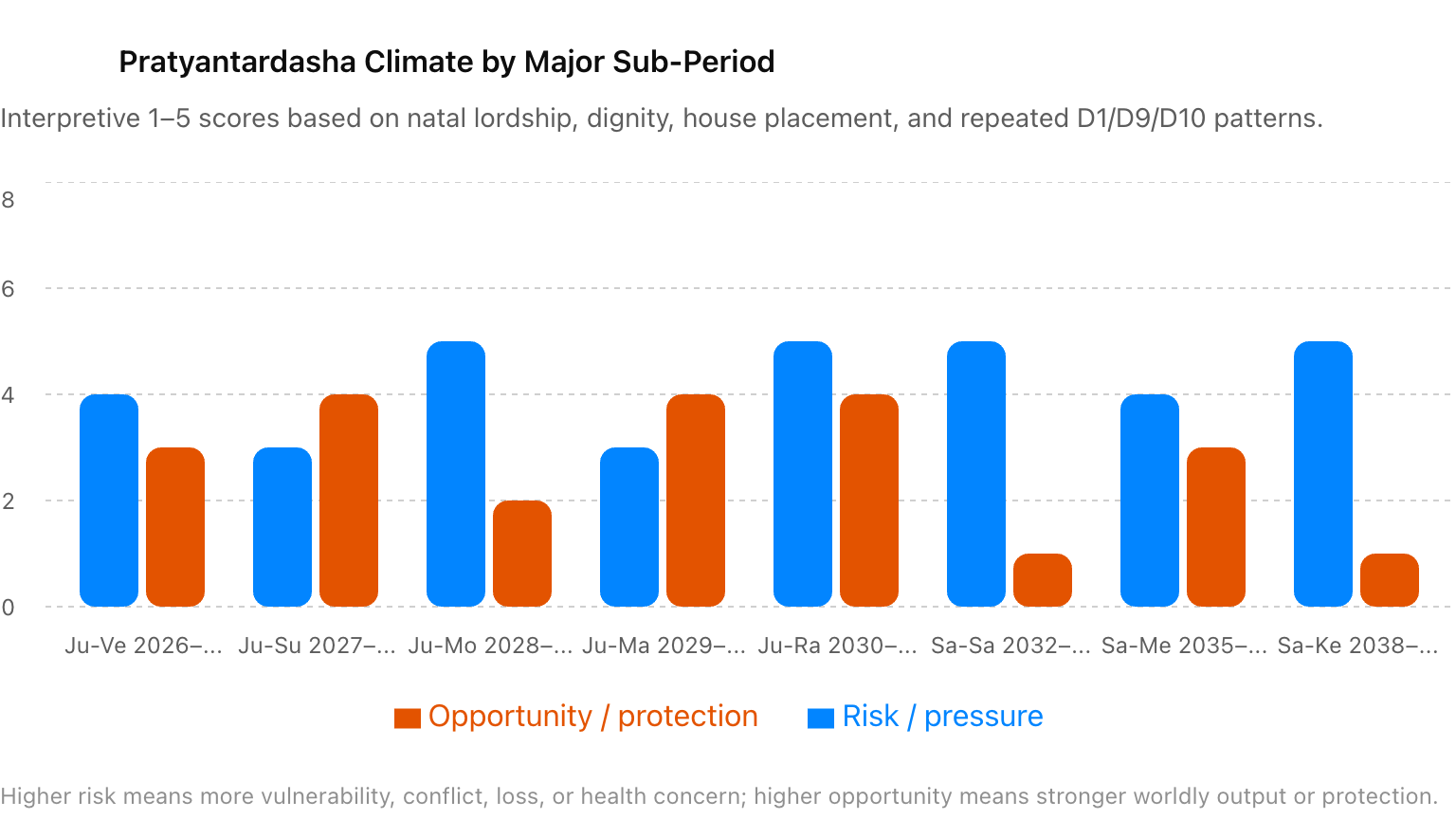
Pratyantardasha Climate by Major Sub-Period
2. Most auspicious / productive windows
Here “auspicious” means capacity to produce worldly success, protection, gains, visibility, or strategic advantage. It does not necessarily mean peaceful or morally clean.
Ju-Ve-Me - 2026-11-15 to 2027-04-02 - Mercury is strong in own sign Gemini in the 11th. Good for networks, messaging, gains, alliances, fundraising, media, argument, and strategic communication. Still under Venus in the 12th, so benefits come with cost or legal/institutional pressure.
Ju-Su-Ma - 2027-07-07 to 2027-07-24 - Sun is Lagna lord in 10th; Mars is yogakaraka in Lagna. Strong for assertion, victory impulse, command, executive action. Brief but potent.
Ju-Su-Ju - 2027-09-06 to 2027-10-14 - Jupiter triggers its own Mahadasha. Can give protection, counsel, legal/intellectual framing, and recovery after Rahu turbulence. But Jupiter is also 8th lord, so not purely benefic.
Ju-Su-Me - 2027-11-30 to 2028-01-10 - Strong Mercury again. Good for messaging, negotiation, finance, networks, speech, and tactical advantage.
Ju-Ma-Ju - 2029-09-25 to 2029-11-09 - Mars Antardasha is generally more favorable because Mars is yogakaraka in Lagna. Jupiter pratyantar adds protection and strategic counsel.
Ju-Ma-Me - 2030-01-02 to 2030-02-20 - Strong for deals, speech, commercial gains, media, and network leverage.
Ju-Ma-Su - 2030-05-07 to 2030-05-24 - Sun and Mars together are powerful for authority, assertion, command, public will, and personal force. Short but strong.
Sa-Me-Me - 2035-11-18 to 2036-04-05 - Within difficult Saturn Mahadasha, this is comparatively one of the better periods. Mercury is strong in the 11th and can produce gains, communication, influence, and network support.
Sa-Me-Ju - 2037-10-14 to 2038-02-23 - Better than surrounding Saturn/Ketu-type periods. Jupiter gives some protection, counsel, and stabilizing wisdom, though still mixed due to 8th lordship.
The strongest productive planets in this chart are Sun, Mars, and Mercury. So periods involving these lords tend to produce action, visibility, gains, or command. But Sun is joined Rahu, Mars is aggressive, and Mercury rules the 2nd/11th, so even the “good” periods tend to be transactional, combative, or image-driven rather than serene.
3. Pronounced inauspicious windows before Saturn Mahadasha
Ju-Ve-Sa: 2026-06-14 to 2026-11-15
This is one of the first sharply difficult windows in the detailed sequence.
Why:
Jupiter Mahadasha = 5th/8th lord in 2ndVenus Antardasha = 10th lord in 12th with SaturnSaturn Pratyantar = 6th/7th lord, weak, in 12thSaturn is the weakest classical planet in the chart: Shad Bala 0.59, great-enemy dignity, dead avastha, 6th/7th lord, placed in the 12th. This period activates enemies, litigation, contracts, public opponents, losses, confinement/institutional settings, and health vulnerability.
Traditional health concern: Saturn as 6th lord in 12th can show chronic weakness, hospitalization-type themes, fatigue, depletion, hidden disease, or consequences of accumulated strain. Because Saturn is also 7th lord and Darakaraka, open enemies/partners/contracts can also become a vehicle of loss.
Judgment: highly inauspicious, especially for legal pressure, partnership/public-opponent pressure, loss, and health strain.
Ju-Ve-Ke: 2027-04-02 to 2027-05-29
This is another sensitive window.
Ketu is in the 4th with debilitated Moon. The 4th governs heart, chest, emotional stability, residence, vehicles, and inner peace. Ketu cuts, separates, exposes, and destabilizes.
Because this occurs at the end of Venus Antardasha, the 10th lord in the 12th, the combination can bring public-career loss, emotional rupture, hidden institutional pressure, retreat, or sudden destabilization.
Judgment: high risk, especially for private-life instability, health vulnerability, residence/property issues, and sudden reversals.
4. Jupiter/Sun Antardasha: 2027-05-29 to 2028-03-16
This period is more powerful than peaceful.
Sun is the Lagna lord, Atmakaraka, and strongest Shad Bala planet. It sits in the 10th with Rahu. So Jupiter/Sun can produce public visibility, command, assertion of authority, and a renewed centrality of identity.
But Sun is eclipsed by Rahu, so the public field becomes volatile.
Most notable windows:
Ju-Su-Su - 2027-05-29 to 2027-06-12 - Strong assertion of identity and authority. Good for visibility, but ego/body/public office themes are exposed.
Ju-Su-Mo - 2027-06-12 to 2027-07-07 - More difficult. Moon is debilitated, 12th lord, with Ketu. Health, emotional stability, home/private matters become sensitive.
Ju-Su-Ma - 2027-07-07 to 2027-07-24 - Strong action period. Mars protects as yogakaraka, but can also bring aggression, accident risk, conflict.
Ju-Su-Ra - 2027-07-24 to 2027-09-06 - Very volatile. Sun and Rahu are conjoined natally in the 10th. Public controversy, authority crisis, scandal, legal/political visibility, or reputation shock.
Ju-Su-Sa - 2027-10-14 to 2027-11-30 - Inauspicious. Saturn brings legal, contractual, health, and loss themes.
Ju-Su-Ke - 2028-01-10 to 2028-01-27
Short but sharp. Ketu can bring sudden severance, private instability, or health sensitivity.
Most dangerous part of Jupiter/Sun: Ju-Su-Ra, followed by Ju-Su-Sa and Ju-Su-Ke.
Most productive part: Ju-Su-Ma, Ju-Su-Ju, Ju-Su-Me.
5. Jupiter/Moon Antardasha: 2028-03-16 to 2029-07-16
This is one of the most difficult major stretches before Saturn Mahadasha.
Moon is:
12th lordDebilitated in ScorpioConjoined KetuIn the 4th houseAmatyakarakaThis activates loss, isolation, sleep/health disturbances, emotional instability, homeland/property themes, the heart/chest region, residence, and private-life unrest. Because Moon is Amatyakaraka, it also affects functional public conduct and career operations.
Most sensitive windows:
Ju-Mo-Mo - 2028-03-16 to 2028-04-25 - Very sensitive. Moon repeats itself: debilitated 12th lord with Ketu. Health, emotional, home, and private stability concerns.
Ju-Mo-Ra - 2028-05-24 to 2028-08-05 - Very volatile. Rahu activates the 10th side of the eclipse axis opposite Moon/Ketu. Public/private crisis pattern.
Ju-Mo-Sa - 2028-10-09 to 2028-12-25 - One of the harshest in this Antardasha. Moon + Saturn combines weakness, loss, health depletion, legal/contractual burden, and isolation themes.
Ju-Mo-Ke - 2029-03-04 to 2029-04-01 - Short but dangerous. Ketu is with Moon natally, so this repeats the natal affliction.
Ju-Mo-Ve - 2029-04-01 to 2029-06-22 - Career/loss/relationship/expense themes. Venus is 10th lord in 12th with Saturn. Mixed but pressured.
Judgment: Jupiter/Moon is broadly inauspicious, especially for health, inner stability, residence/property, and public functioning under emotional stress.
The most concerning health/danger windows here are:
2028-03-16 to 2028-04-252028-05-24 to 2028-08-052028-10-09 to 2028-12-252029-03-04 to 2029-04-016. Jupiter/Mars Antardasha: 2029-07-16 to 2030-06-22
This is more productive because Mars is the yogakaraka for Leo Lagna and sits in the 1st house.
Mars gives strength, vitality, command, property karma, courage, and the ability to fight. But Mars also gives conflict, heat, inflammation, weapons, accidents, and sudden force. In an elderly native’s chart, Mars periods are not automatically safe just because Mars is favorable.
Most favorable:
Ju-Ma-Ju: 2029-09-25 to 2029-11-09Ju-Ma-Me: 2030-01-02 to 2030-02-20Ju-Ma-Su: 2030-05-07 to 2030-05-24Most dangerous:
Ju-Ma-Ra: 2029-08-05 to 2029-09-25Ju-Ma-Sa: 2029-11-09 to 2030-01-02Ju-Ma-Ke: 2030-02-20 to 2030-03-11Ju-Ma-Mo: 2030-05-24 to 2030-06-22Why these are dangerous:
Rahu with Mars gives explosive public conflict and unpredictable events.
Saturn with Mars gives strain, obstruction, injury, disease pressure, or severe conflict.
Ketu with Mars gives sudden cutting, accidents, surgery-type symbolism, or rupture.
Moon with Mars activates the debilitated Moon/Ketu 4th house by Mars’s aspect.
Judgment: strong for action, not peaceful; mixed auspicious with acute danger pockets.
7. Jupiter/Rahu Antardasha: 2030-06-22 to 2032-11-14
This is one of the most consequential and unstable periods in the whole sequence.
Rahu is in the 10th with the Sun. It is a massive public visibility and disruption signature. Under Jupiter Mahadasha, Rahu Antardasha can bring extraordinary public events, amplification, political/legal spectacle, and reputation-defining developments.
But Rahu is not a stable benefic. It magnifies and destabilizes.
Most important windows:
Ju-Ra-Ra - 2030-06-22 to 2030-10-31 - Pure Rahu trigger. High public volatility, controversy, sudden developments, and reputation stress.
Ju-Ra-Ju - 2030-10-31 to 2031-02-25 - Some protection through Jupiter, but also 8th-house crisis activation.
Ju-Ra-Sa - 2031-02-25 to 2031-07-14 - Very inauspicious. Rahu + weak Saturn: legal pressure, health depletion, public enemies, losses, institutional burden.
Ju-Ra-Ke - 2031-11-15 to 2032-01-05 - Nodal axis fully activated. Sudden break, reversal, separation, or destabilization.
Ju-Ra-Ve - 2032-01-05 to 2032-05-30 - Career/loss/relationship/expense themes; public visibility with hidden costs.
Ju-Ra-Su - 2032-05-30 to 2032-07-13 - Extremely public. Sun/Rahu natal conjunction is activated. Authority, body, ego, office, legitimacy, and reputation under pressure.
Ju-Ra-Mo - 2032-07-13 to 2032-09-24 - Health/private-life concern. Moon is debilitated with Ketu.
Ju-Ra-Ma - 2032-09-24 to 2032-11-14 - Aggressive, confrontational, forceful; can give action but also acute danger.
The most dangerous Jupiter/Rahu windows are:
2030-06-22 to 2030-10-312031-02-25 to 2031-07-142031-11-15 to 2032-01-052032-05-30 to 2032-09-242032-09-24 to 2032-11-14This whole Antardasha is volatile because it leads directly into Saturn Mahadasha, which is much harsher for this chart.
8. Saturn Mahadasha begins: 2032-11-14
This is the biggest shift in the sequence.
Natal Saturn is the most problematic classical planet in the chart:
Saturn rules 6th and 7thPlaced in 12thConjoined VenusDarakarakaGreat enemy dignityDead avasthaShad Bala only 0.59Saturn Mahadasha can bring:
chronic health issues;
hospitalization/confinement/isolation symbolism;
litigation/enemies;
contractual burdens;
partnership karma;
losses and expenses;
weakening of vitality;
karmic consequences of prior choices.
Because Saturn rules the 7th, it also acts as a maraka-type planet for Leo Lagna. Because it rules the 6th, it activates disease, enemies, conflict, and service/servitude. Because it sits in the 12th, it connects these to loss, isolation, institutions, sleep, hospitalization, foreignness, and withdrawal.
9. Saturn/Saturn Antardasha: 2032-11-14 to 2035-11-18
This is one of the most inauspicious stretches in the full dataset.
Especially severe:
Sa-Sa-Sa - 2032-11-14 to 2033-05-07 - Triple Saturn. Very high health, loss, legal, isolation, partnership, and vitality concern.
Sa-Sa-Ke - 2033-10-10 to 2033-12-13 - Sudden destabilization, separative events, health vulnerability.
Sa-Sa-Ve - 2033-12-13 to 2034-06-14 - Saturn and Venus are conjoined natally in the 12th. Career, relationship, luxury, loss, hospitalization/institution themes. Very difficult.
Sa-Sa-Mo - 2034-08-08 to 2034-11-08 - Moon is debilitated 12th lord with Ketu. Health/private stability concern.
Sa-Sa-Ra - 2035-01-11 to 2035-06-25 - Saturn + Rahu is harsh: public pressure, chronic strain, legal/enemy themes, unpredictable danger.
Best within Saturn/Saturn:
Sa-Sa-Ju: 2035-06-25 to 2035-11-18Jupiter offers some protection, but because it is also 8th lord, this is only relatively better, not fully safe.
Judgment: Saturn/Saturn is the first truly severe long health/danger period in this sequence.
10. Saturn/Mercury Antardasha: 2035-11-18 to 2038-07-28
This is mixed and somewhat better than Saturn/Saturn because Mercury is strong in own sign in the 11th.
Mercury can give:
communications;
networks;
gains;
strategic allies;
business;
speech;
media;
influence.
But Mercury rules the 2nd and 11th. The 2nd is a maraka house. In Saturn Mahadasha, Mercury can still produce material gains while not fully protecting health.
Favorable windows:
Sa-Me-Me: 2035-11-18 to 2036-04-05Sa-Me-Ju: 2037-10-14 to 2038-02-23More dangerous windows:
Sa-Me-Ke: 2036-04-05 to 2036-06-02Sa-Me-Mo: 2037-01-01 to 2037-03-24Sa-Me-Ra: 2037-05-20 to 2037-10-14Sa-Me-Sa: 2038-02-23 to 2038-07-28The most serious within this Antardasha is Sa-Me-Sa, because Saturn repeats under Saturn Mahadasha. This can bring chronic health pressure, losses, legal burden, and bodily depletion.
Judgment: mixed; capable of gains and speech/network strength, but still vulnerable due to Saturn background.
11. Saturn/Ketu Antardasha: begins 2038-07-28
This is highly sensitive.
Ketu is in the 4th house with debilitated Moon. Saturn is the weak 6th/7th lord in the 12th. Saturn/Ketu connects:
6th: disease, enemies, litigation7th: partners, opponents, maraka themes12th: loss, isolation, confinement, hospitalization4th: heart, home, emotional foundation, chest, residenceMoon: body fluids, mind, public receptivityKetu: separation, cutting, suddennessEvery visible Saturn/Ketu pratyantar is difficult, but the worst are:
Sa-Ke-Ke - 2038-07-28 to 2038-08-21 - Ketu repeats itself. Sudden separation, sharp health vulnerability, private/home instability.
Sa-Ke-Mo - 2038-11-17 to 2038-12-20 - Moon is debilitated with Ketu. Very sensitive for health, emotional stability, chest/heart/private residence themes.
Sa-Ke-Ma - 2038-12-20 to 2039-01-13 - Mars can be protective as yogakaraka, but with Ketu it can indicate acute events, accidents, inflammation, surgery-type symbolism, or conflict.
Sa-Ke-Ra - begins 2039-01-13 - Nodal axis activated under Saturn/Ketu. Very high volatility and danger. End date not visible in uploaded data.
Judgment: Saturn/Ketu is one of the most dangerous sections of the uploaded sequence.
12. Ranked danger periods
These are the periods I would mark as most pronounced for health concern, danger, loss, or severe destabilization.
Tier 1: highest concern
Sa-Sa-Sa 2032-11-14 to 2033-05-07Sa-Sa-Ve 2033-12-13 to 2034-06-14Sa-Sa-Ra 2035-01-11 to 2035-06-25Sa-Ke-Ke 2038-07-28 to 2038-08-21Sa-Ke-Mo 2038-11-17 to 2038-12-20Sa-Ke-Ma 2038-12-20 to 2039-01-13Sa-Ke-Ra begins 2039-01-13Reason: Saturn Mahadasha activates the weakest and most dangerous planet in the natal chart. Ketu and Moon triggers activate the afflicted 4th-house Moon/Ketu. Rahu triggers activate the eclipse axis. Venus triggers the natal 12th-house Venus/Saturn conjunction.
Tier 2: serious concern
Ju-Ve-Sa 2026-06-14 to 2026-11-15Ju-Ve-Ke 2027-04-02 to 2027-05-29Ju-Mo-Mo 2028-03-16 to 2028-04-25Ju-Mo-Ra 2028-05-24 to 2028-08-05Ju-Mo-Sa 2028-10-09 to 2028-12-25Ju-Mo-Ke 2029-03-04 to 2029-04-01Ju-Ra-Sa 2031-02-25 to 2031-07-14Ju-Ra-Ke 2031-11-15 to 2032-01-05Ju-Ra-Su 2032-05-30 to 2032-07-13Ju-Ra-Mo 2032-07-13 to 2032-09-24Reason: These combine Jupiter’s 8th-lord background with Saturn, Ketu, Rahu, Moon, or Sun/Rahu activations.
Tier 3: volatile but also productive
Ju-Su-Ra 2027-07-24 to 2027-09-06Ju-Ma-Ra 2029-08-05 to 2029-09-25Ju-Ma-Sa 2029-11-09 to 2030-01-02Ju-Ma-Ke 2030-02-20 to 2030-03-11Ju-Ra-Ra 2030-06-22 to 2030-10-31Ju-Ra-Ma 2032-09-24 to 2032-11-14Sa-Me-Ra 2037-05-20 to 2037-10-14Sa-Me-Sa 2038-02-23 to 2038-07-28Reason: These can produce visible action or force, but they are unstable. Mars/Rahu, Mars/Ketu, Saturn/Rahu, and Sun/Rahu signatures can give confrontation, sudden developments, accident-like patterns, reputation crises, or explosive public events.
13. Best periods for gains, visibility, and protection
Ju-Ve-Me 2026-11-15 to 2027-04-02Ju-Su-Ma 2027-07-07 to 2027-07-24Ju-Su-Ju 2027-09-06 to 2027-10-14Ju-Su-Me 2027-11-30 to 2028-01-10Ju-Ma-Ju 2029-09-25 to 2029-11-09Ju-Ma-Me 2030-01-02 to 2030-02-20Ju-Ma-Su 2030-05-07 to 2030-05-24Sa-Me-Me 2035-11-18 to 2036-04-05Sa-Me-Ju 2037-10-14 to 2038-02-23These are better because they emphasize Mercury, Mars, Sun, or Jupiter in relatively constructive ways.
But note: after 2032-11-14, even the better periods occur under Saturn Mahadasha. So the baseline becomes heavier, more constrained, and more health-sensitive.
14. Bottom-line traditional judgment
The detailed pratyantardasha sequence shows three broad phases:
2026-02 to 2027-05: Jupiter/Venus — public-career/loss/legal/12th-house themes.Most dangerous: Ju-Ve-Sa and Ju-Ve-Ke.2027-05 to 2032-11: Jupiter/Sun, Moon, Mars, Rahu — public power, volatility, health stress, and eclipse-axis activation.Most difficult: Jupiter/Moon and Jupiter/Rahu.Most productive: Jupiter/Sun and Jupiter/Mars.2032-11 onward: Saturn Mahadasha — major deterioration in chart support.Saturn/Saturn and Saturn/Ketu are the most concerning for health, loss, isolation, legal burden, and danger.The most pronounced overall danger sequence begins with the transition into Saturn Mahadasha on 2032-11-14. Before that, the most sensitive windows are Jupiter/Venus/Saturn, Jupiter/Moon, and Jupiter/Rahu.
Pratyantardasha Climate by Major Sub-Period
Interpretive 1–5 scores based on natal lordship, dignity, house placement, and repeated D1/D9/D10 patterns.
period opportunity riskJu-Ve 2026–2027 3 4Ju-Su 2027–2028 4 3Ju-Mo 2028–2029 2 5Ju-Ma 2029–2030 4 3Ju-Ra 2030–2032 4 5Sa-Sa 2032–2035 1 5Sa-Me 2035–2038 3 4Sa-Ke 2038–2039 1 5
Created by Barry Wadsworth with the help of Parashara’s Light and ChatGPT.